跳到内容
跳到内容 
I’m writing this for brand owners and buyers who want a product line that sells cleanly both online and offline, without ending up with “pretty paddles that don’t move.”
This is not a “which core is best” article. This is about how to build an assortment that your customers understand in 10 seconds, retailers can stock confidently, and you can replenish without dead inventory.
The retail truth: people don’t buy “technology,” they buy a clear choice
In retail (and e-commerce), the biggest sales killer is confusion. If two pickleball paddles look similar and your explanation feels technical, your customers hesitate, and hesitation becomes no sale.
That’s why the best-selling brands don’t start with 12 models. They start with a small set where each SKU has a job.
-
One SKU to convert beginners fast
-
One SKU to become the main seller and profit engine
-
One SKU to create brand identity and upgrade desire
If you get these three roles right, everything else becomes easier: pricing, marketing, reviews, and replenishment
Before you pick SKUs, pick your “channel reality”
When buyers tell me they want “online + offline,” I ask one thing first: which channel will punish you faster if you get it wrong?
Offline retail punishes confusion and returns.
Online punishes unclear positioning and bad reviews.
So the safest starting point is a clean 3-model ladder, and then expand to 6 SKUs only after you see real sales signals
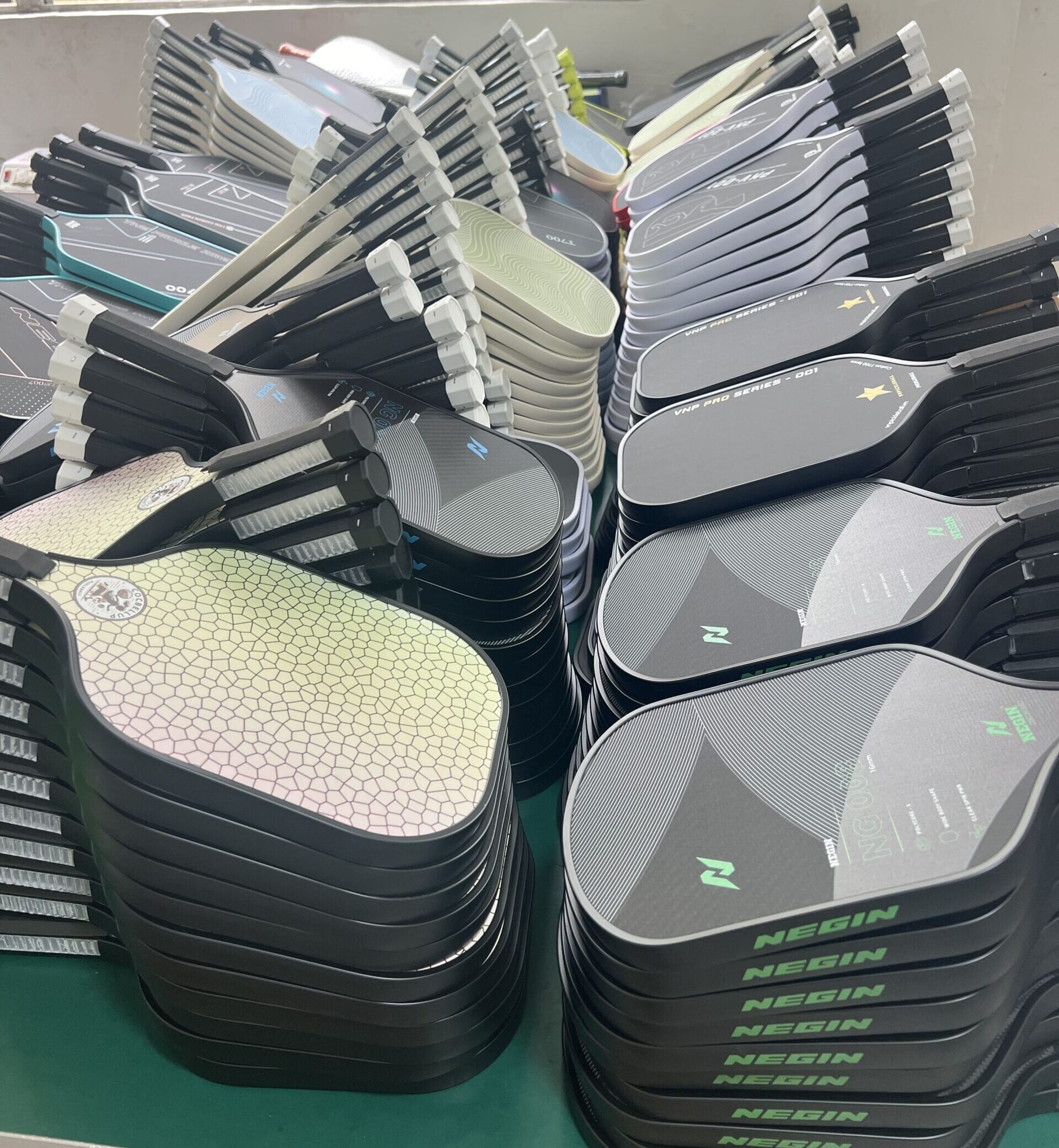
My recommended 3-model launch line (online + offline friendly)
Because you are selling both online and offline, my suggestion is to start with 3 models to build a clean product line:
-
Entry model: for new players / clubs (cold-press T700, 13 or 16 mm)
-
Premium model: main seller (thermoformed T700, 16 mm, foam-injected edge)
-
Flagship model: for A-level players (Gen 4 core or TruFoam core + EVA–EPP Gen 5 core + raw T700, 16 mm)
Here’s how I would position them so your customers instantly understand the ladder:
-
Entry = Comfort + Easy Control (lowest return risk)
-
Premium = “This is the one most people should buy” (profit engine)
-
Flagship = “Best feel / best tech / best identity” (brand builder)
If you’re short on budget, this 3-SKU ladder is enough to cover most retail and e-commerce needs without inventory pressure.
The 3-SKU ladder in a simple table (easy for buyers to copy)
3 SKU launch blueprint
| SKU Role | Who It’s For | Core Message | Safe Spec Direction |
|---|---|---|---|
| Entry | Beginners, clubs, schools | Soft, forgiving, easy to control | Cold-press T700, 13mm or 16mm |
| Premium | Most players, best seller | Balanced performance + value | Thermoformed T700, 16mm, foam edge |
| Flagship | A-level / advanced buyers | Best feel + tech identity | Gen 4 / TruFoam or EVA–EPP Gen 5 + raw T700, 16mm |
When you should expand from 3 SKUs to 6 SKUs
I don’t recommend expanding just because “competitors have more models.” Expand only when you have data.
Here are the clean signals that tell me a brand is ready to go from 3 to 6:
-
Your premium model is consistently re-ordered (not just one-time)
-
Your entry model converts well but some of your customers ask for “more power” or “more spin”
-
Your flagship sells, but some of your customers ask for a lower-priced “almost flagship” option
That’s when 6 SKUs becomes a tool to increase revenue, not a tool to increase inventory

The most stable 6-SKU set for brands (retail-friendly)
A stable 6-SKU set is basically: 2 entry + 2 main sellers + 1 power option + 1 flagship.
Here’s the logic: you cover the biggest search and buying intents (control / power / spin / comfort / sweet spot) without making your line confusing for your customers.
-
Entry A: Soft & forgiving
-
Entry B: Lightweight or extra control
-
Main A: Control + spin (best seller)
-
Main B: All-court balanced (best seller)
-
Power: For hitters / singles / fast hands
-
Flagship: Highest identity + best feel
If you want, we can map each SKU to a clear name system (Control / Power / Comfort) so your website and packaging “sell for you.”
The part most brands miss: keep differences big, not subtle
If two SKUs feel 90% the same, your customers won’t pay for the higher one, and retailers won’t stock both.
So I like to make sure each step in the ladder changes something your customers can actually feel:
-
Comfort change: vibration and softness
-
Control change: dwell time and stability
-
Power change: rebound speed and “pop”
-
Sweet spot change: forgiveness across off-center hits
This is how you avoid dead stock: each SKU has a buyer and a reason.
A real story I’ve seen: how brands get stuck with inventory (and how to fix it)
I’ve seen a new brand launch with 7–8 SKUs right away. On paper it looked “professional,” but in retail it created a problem: store staff couldn’t explain the differences, and your customers defaulted to the cheapest model.
They didn’t lose because the paddles were bad. They lost because the ladder was unclear for your customers.
The fix was simple: we helped them compress the line into a clean 3-SKU ladder, then re-expand to 6 only after the premium model proved repeat demand.
Once the story became simple, their sell-through improved and inventory pressure dropped.
A buyer’s SKU decision checklist (fast and practical)
Before you finalize your lineup, ask yourself:
-
Do I have a clear 3-level ladder (Entry / Premium / Flagship)?
-
Can each SKU be explained in one sentence without technical words for your customers?
-
Does each SKU match a real channel need (online/offline/distributor)?
-
Are my differences “felt” (comfort/control/power/sweet spot), not “named”?
-
Am I starting small, then expanding based on sales signals?
If you can answer these cleanly, your product line will feel “retail-ready” instead of “factory catalog.”
People Also Ask (FAQ)
If I’m a new brand, should I launch with 3 SKUs or 6 SKUs?
A: If your goal is to sell both online and offline without dead stock, start with 3 SKUs. Three models create a clean ladder that your customers can understand fast, and it keeps your inventory risk low. Expand to 6 only after your premium model shows repeat demand from your customers.
What is the safest “main seller” spec for most brands?
A: For most brands, the safest main seller is a balanced, easy-to-sell setup that fits the widest group of your customers. A thermoformed T700 16mm with foam-injected edge is a common choice because it’s easier to position as “the one most people should buy.”
How do I prevent dead stock when I add more SKUs?
A: Only add an SKU if it creates a difference your customers can feel in 10 seconds, comfort, control, power, or sweet spot. Avoid adding SKUs that are only cosmetic changes. Your customers won’t pay more for “almost the same,” and retailers won’t stock both.
Why do some brands fail even with good paddles?
A: Because your customers don’t buy a paddle “by spec sheet”, they buy a clear choice. If your ladder is unclear, store staff can’t explain it, your customers hesitate, and the cheapest model becomes the default. Clean positioning beats “more models.”
What are the most buyer-friendly names for SKUs (so your customers understand fast)?
A: Use a simple system your customers already search for: Comfort / Control / Power / Flagship. Pair it with one clear level word (Entry / Pro / Elite). The goal is that your customers can self-select without reading a long explanation.
A practical note from iAcesport
I don’t believe the best product line is the one with the most models. I believe the best product line is the one your customers understand immediately, and your warehouse can replenish calmly.
If you tell me your target channel (online, offline retail, distributor) and your target price range, I can help you map a clean 3-SKU start, and a stable 6-SKU expansion, without turning your inventory into a gamble.