跳到内容
跳到内容 
A quick confession
I’ve seen this too many times: a buyer thinks they’re buying a “carbon fiber paddle,” but the factory is really selling a carbon-looking surface, or a vague “carbon composite” that could mean half a dozen different stacks. The sample feels okay, the first batch ships, and then the real pain starts,reviews say the paddles feel inconsistent, the “carbon” story gets questioned, and your team wastes weeks explaining instead of selling.
So in this guide, I’m not going to fight over buzzwords. I’ll show you how I actually break down surface materials with our customers: what each term can mean, how it feels, what can go wrong in mass production, and which choices fit different brand stages (first order vs profit line vs flagship).
The 60-second truth table
| Word on websites | What it can honestly mean | How buyers get tricked | What you must ask (one line) |
|---|---|---|---|
| Carbon Fiber | Real carbon fiber fabric/UD inside the face | “Carbon look” print or carbon-colored coating sold as carbon | “UD or woven? T300/T700? How many face layers?” |
| Carbon Composite | A composite face (fiber + resin). Fiber type may vary | Sounds premium, hides the real fiber mix | “What fibers are in the stack? Any fiberglass? Which layers?” |
| Graphite | Often a marketing label in sporting goods | Ambiguous word; can mean “carbon-ish” | “Is there real carbon fabric/UD? Show macro before topcoat.” |
| Carbon / carbon ink / carbon black | Color/pigment/printing/filler terms | The word “carbon” makes buyers assume carbon fiber | “Is carbon fiber fabric used structurally? If yes, which weave/UD?” |
Most buyers don’t lose money because they chose the “wrong” material. They lose money because they bought a word instead of a spec.
What “graphite” usually means in paddles (and why it’s risky to rely on it)
In paddle sourcing, “graphite” is often used like a category label, not a technical spec. Two factories can both say “graphite,” but one uses real carbon fabric and another uses a carbon-pattern layer that looks similar from far away. If you build your website copy around that word, you’re basically building on sand.
So treat “graphite face” as unknown until the supplier writes: carbon type (UD/woven), grade (T300/T700), and the actual layup.
Surface material families you actually choose (and what each one feels like)
Below is the practical list I use in OEM conversations. I’ll keep it simple: what it is → what it feels like → what goes wrong → best fit by brand stage.
UD Raw Carbon Fiber (T300 / T700)
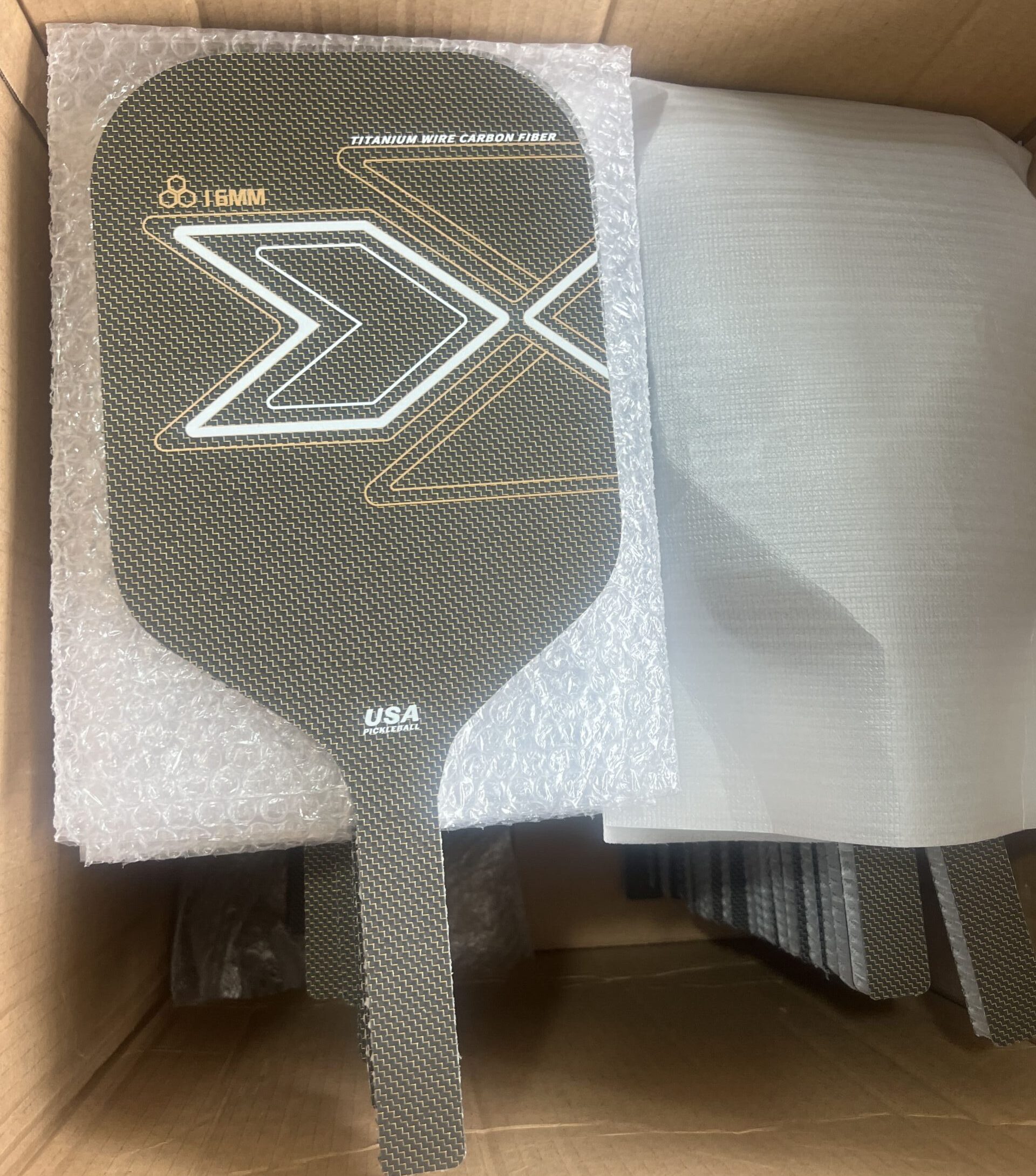
What it is: UD (unidirectional) carbon means fibers are mainly aligned in one direction under the top layer. This is one of the cleanest “carbon face” specs because it’s easy to define and repeat.
What it feels like: Clean response and a crisp, performance-forward feel. Players often describe it as “direct” and “connected.”
What goes wrong: Most failures are not “UD is bad.” They’re “the surface process drifted” or “the layup silently changed between sample and mass production.”
Best fit by stage:
-
Stage 1 (first order / new brand): UD T300 is usually the safest carbon start—stable story, stable cost, easier consistency.
-
Stage 2 (profit / main seller): UD T700 is a strong hero SKU when you can lock process + weight range.
-
Stage 3 (flagship): Still great, but flagship often needs a visible differentiator (texture method, weave identity, or premium core story).
Woven Carbon: 3K / 12K / 18K
What it is: 3K/12K/18K are weave identities. In real OEM projects, buyers choose them mostly for visual premium identity and how texture/topcoat sits on the weave.
What it feels like: The feel difference is usually subtle compared to UD. The bigger benefit is how “premium” it looks and how easy it is to justify pricing.
What goes wrong: The classic mistake is paying for a premium weave… then covering it with heavy background colors so your customers can’t see it.
Best fit by stage:
-
Stage 1: Not necessary unless your brand is design-first.
-
Stage 2: Excellent for a premium-looking main seller, if your design keeps the weave visible.
-
Stage 3: Very suitable for flagship because your customers pay for identity.
Kevlar
What it is: Kevlar is for premium positioning and a distinctive material identity.
What it feels like: Many players describe it as having a unique “touch character,” often perceived as more controlled, though the final feel depends heavily on the full build (core + layup).
What goes wrong: Kevlar gets wasted when you hide it under full-coverage artwork. You pay flagship cost and get a normal-looking face.
Best fit by stage:
-
Stage 1: Usually not recommended as your first hero unless you already have demand.
-
Stage 2: Works as a premium SKU once you have stable process control.
-
Stage 3: Best fit for flagship, if the material identity stays visible and the spec is locked.
Titanium “Weave” / Titanium Layer
What it is: In our case, “titanium weave” is not just a name. It means the face material includes visible metallic silver threads woven into the surface. We also do color-thread versions like red, gold, purple, or green.
What it feels like: It’s mainly chosen as a premium surface identity. The feel is performance-focused, but the bigger value is the high-end look and the “this is clearly different” impression when your customers see it in hand.
What goes wrong: The biggest mistake is paying for titanium thread and then covering it with heavy background colors or full-coverage artwork, so the threads disappear. If you choose titanium thread, keep the design cleaner so the weave stays visible and the premium story stays believable.
Best fit by stage:
-
Stage 1: Not needed.
-
Stage 2: Only if you have a clear story and verified structure.
-
Stage 3: Can work as flagship identity if it’s truly spec’d and visually meaningful.
Fiberglass
What it is: Fiberglass is extremely common in entry/training models. Some factories label blends as “carbon composite.” That’s not always wrong,but it’s incomplete without the fiber breakdown.
What it feels like: Softer, more forgiving, easier for beginners to enjoy.
What goes wrong: The problem is usually marketing, when it’s sold as “full carbon,” buyers later get challenged
Best fit by stage:
-
Stage 1: One of the best choices for fast entry and low complaint risk.
-
Stage 2: Great as your traffic SKU even if your main seller upgrades to T700.
-
Stage 3: Not typical flagship unless your flagship story is elsewhere.
The “fake carbon” trap: carbon ink / carbon black is not carbon fiber
Here’s the simple truth: “carbon ink / carbon black” is commonly related to printing, pigment, or fillers. It can make something look “carbon,” but it is not carbon fiber fabric. If a quote is unusually low but the seller says “same as carbon fiber,” assume it’s not the same until they prove it with a written spec + macro evidence
The 3 checks you use to stop material scams fast
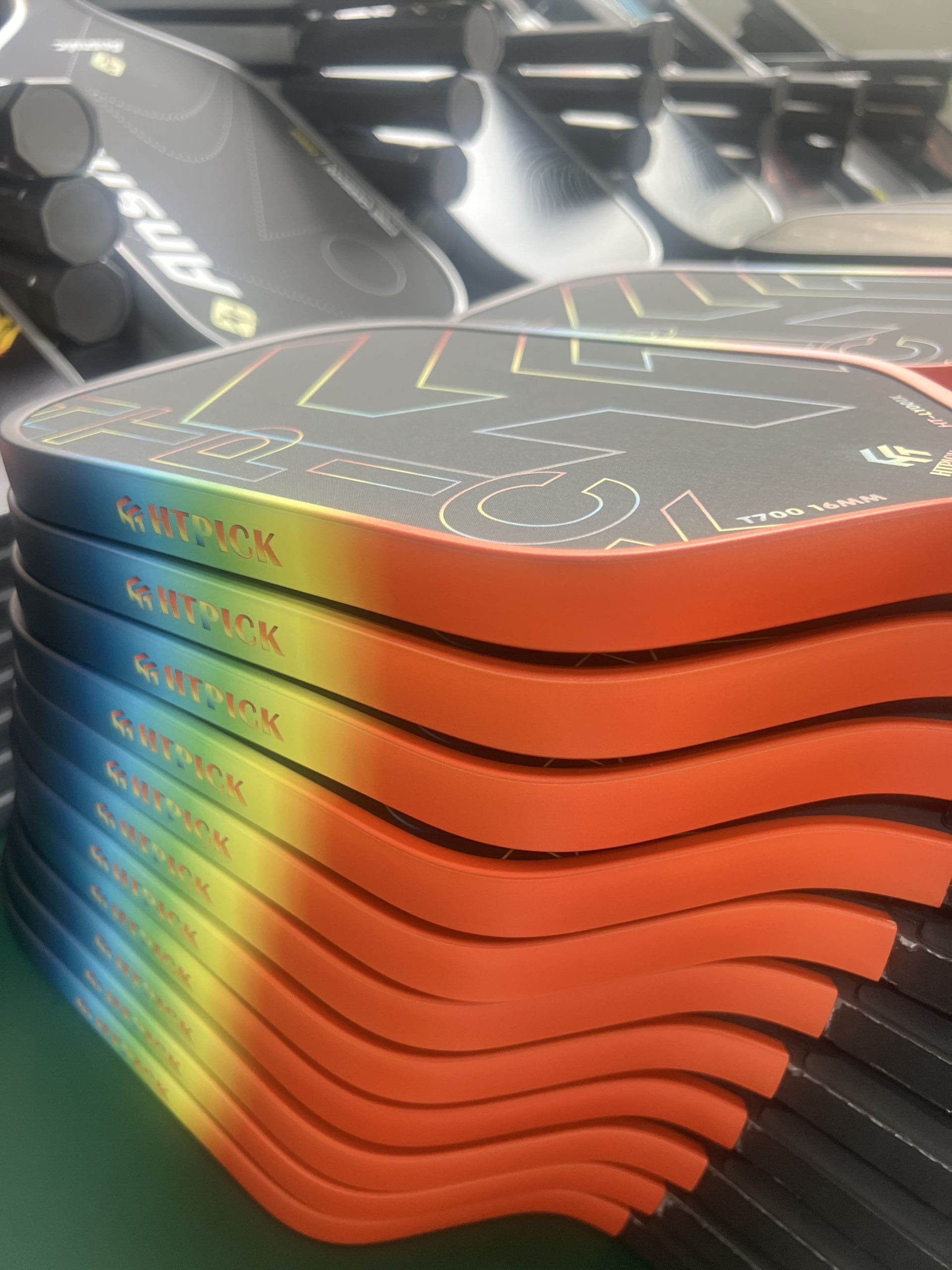
Ask for a macro photo before final topcoat
A real weave/UD has structure you can see up close. Prints often look flat and “too perfect.”
Force a one-paragraph written spec
If they can’t write UD/woven + grade + layup clearly, you don’t have a controlled product. You have a hope-and-pray product.
Lock the “no-change items” after sample approval
Most disasters happen when the sample is one thing and mass production quietly drifts.
Stage-based selection guide: what I’d recommend for your brand right now
Stage 1: First order, new brand, you need stability (100–500 pcs mindset)
At this stage, early complaints rarely start from “spin is low.” They start from “this feels different from the other one” or “this doesn’t match what you claimed.” So I’d recommend materials that are easy to repeat and easy to explain:
-
Best choices: Fiberglass face, or UD T300 raw carbon (clean spec, stable cost, lower drift risk)
-
Avoid making your core story: vague “graphite premium,” undefined “titanium,” or Kevlar with full-coverage artwork (you pay premium and your customers can’t see it).
Stage 2: You already sell, now you need profit SKUs and a “hero” model
Now your customers start comparing “why this costs more” and “why this plays better.” This is where UD T700 and premium weave identities work well, if you lock layup + surface method + weight range.
-
Recommended lineup: Keep fiberglass/T300 as entry traffic, and build a UD T700 main seller for margin.
-
Optional upgrade: 3K/12K/18K weave identity for premium-looking SKUs (design must keep weave visible).
Stage 3: Flagship / premium expansion (you need differentiation, not just “carbon”)
At flagship stage, “carbon” is not a differentiator anymore. Identity is. This is where Kevlar, special weaves, or truly defined titanium options can work, but only if your design and spec control match the premium story.
-
Best fit: Kevlar / premium weave identity + durable texture method, with clean designs that show material character.
-
Avoid: Paying for premium fiber while covering it with heavy colors (you lose the reason customers pay more).
Material choice by SKU role (Entry / Profit / Flagship)
| Face material | Entry / Traffic SKU | Profit / Main Seller SKU | Flagship / Premium SKU | The one risk buyers forget |
|---|---|---|---|---|
| Fiberglass | ✅ Best starter | ✅ Great traffic line | △ Not typical | Oversold as “full carbon” |
| UD T300 | ✅ Safe carbon start | ✅ If cost-sensitive | △ Less premium story | Surface process drift |
| UD T700 | △ If budget allows | ✅ Best margin seller | ✅ If paired with story | Batch consistency |
| 3K/12K/18K | △ Design-first | ✅ Premium-looking seller | ✅ Strong identity | Covered by heavy artwork |
| Kevlar | ✗ Usually no | △ One premium SKU | ✅ Flagship positioning | Premium cost, hidden identity |
| Titanium option | ✗ Not needed | △ Only if spec-defined | ✅ If truly defined | Buying the name, not structure |
People Also Ask (FAQ)
Is “graphite” the same as carbon fiber?
Not always. Treat “graphite” as a label until the factory writes UD/woven type, grade, and layup details.
Is “carbon composite” real or just marketing?
It can be real, but it’s incomplete. Composite just means “fiber + resin.” The key is what fiber and what stack.
Are 12K/18K automatically better than 3K?
No. K changes the weave look and how texture/topcoat sits. “Better” depends on your SKU role and design coverage.
How do I avoid paying for fake carbon?
Ask for macro photos pre-topcoat, a one-paragraph face spec, and lock the no-change list after sample approval.
Can iAcesport build paddles that match real carbon face specs?
Yes. We can build UD/woven carbon options (3K/12K/18K), Kevlar, and titanium options , and keep sampling-to-production consistent by locking layup + surface method.
Final note
l’ve heard this the hard way from our customers: buyers don’t lose trust because a paddle isn’t “fancy enough.” They lose trust when the story changes from sample to mass production. That’s why, at iAcesport, I’d rather slow down for one extra round of spec confirmation than rush a batch that you’ll have to explain later
If you tell me your target price point and who your customers are, I can suggest a material + design direction that looks honest, feels consistent, and still gives you room to scale, without paying premium money for a texture or weave that your final artwork will hide anyway.