跳到内容
跳到内容 
A quick truth before we start
Your first order is not the time to “build everything.” It’s the time to build a clean, repeatable product line that your customers understand fast and you can reorder without drama.
Over-customizing at 100–500 pcs usually leads to the same ending: slow decisions, higher risk, and inventory that doesn’t move.
One more real-world detail: the first order is also when your internal workflow is the weakest (new files, new suppliers, new packing process). Keeping it simple protects you from “process mistakes,” not just product mistakes.
If you’ve been stuck in “let me think” mode for days, don’t worry, that’s normal. Most first orders don’t fail because the product is hard. They fail because decisions stay open for too long.
Who this guide is for
This is for new brands, retailers testing a new category, distributors trialing a line, and school/event buyers launching a first set,basically anyone who wants to start smart and scale smoothly.
If you’re a retail buyer, your biggest headache is usually not “can the factory make it,” but “can the factory repeat it every time without surprises.” That’s what this guide is built for.
The goal of a first order
Don’t aim for a “perfect paddle” on day one. Aim for a first order that is:
-
Easy to explain in 5 seconds
-
Easy to reproduce consistently
-
Less likely to trigger early returns
-
Easy to reorder and expand later
A simple mental model: your first order should be a template, not a “special edition.”
Start with this: one message that saves you weeks
Before sampling or mass production, send these five items together (in one message). It makes everything faster and cleaner:
-
Your selling channel: Amazon / DTC / retail shelf / distributor
-
Your target retail price band
-
Your target player level (beginner / intermediate / advanced)
-
Your “must-have” features (top 2 only)
-
Your launch quantity and target ship date
This prevents the most common first-order trap: designing a paddle that doesn’t match the price band.
A tiny add-on that helps a lot: also tell the factory what you don’t want (one sentence). Example: “No extreme power feel and keep it easy to reorder.”
When you send me these five items in one message, I can usually tell in 10 minutes whether the project will be smooth, and I’m not exaggerating.
What to customize NOW
Your “hero spec” must be locked
Pick one “hero” specification you can reorder for the next 6–12 months: shape, thickness, core family, and a reasonable weight range target.
If you change the hero spec too early, reviews become inconsistent and inventory becomes messy.
Practical tip: label your hero spec internally like a “SKU master.” Give it a code and never change it casually.
Confirm your design early (because design matters as much as specs)
Most early complaints don’t start from “spin is low.” They often start from something more basic: the product doesn’t look the way the buyer expected, or the mass-production artwork doesn’t match the approved sample.
And honestly, this is the kind of regret that feels the worst—because the paddle might be “fine,” but it just doesn’t look like a product your customers want to show off.
In OEM projects, face artwork is not just “decoration.” It affects how premium your paddle feels, how customers perceive value, and even which surface/finish method is suitable.
So before sampling or mass production, lock these design items clearly:
-
Final artwork files (front + back)
-
Color references (Pantone if possible)
-
Logo placement rules (what can’t move)
-
Model name + version control (so files don’t drift)
If you do this upfront, you’ll save a ridiculous amount of back-and-forth later.
This one step prevents the most common first-order regret: spending money on a product that is “technically fine” but visually not convincing.
Extra useful detail for you: ask your factory to confirm “what surface finish method matches your artwork style,” because large solid-color designs and clean minimal designs often fit different surface processes.
Your “claim wording” must be safe
For a first order, avoid risky wording on packaging like “legal for all tournaments” unless you have the exact listing/status confirmed for that model.
The safer approach is simple: describe benefits without implying approvals you haven’t verified yet.
A buyer-friendly trick: if you’re unsure, keep performance claims on your website first (easy to edit), and keep packaging wording conservative (hard to reprint).
What to customize LATER (to avoid dead stock at 100–500 pcs)
Don’t over-split your SKUs
At 100–500 pcs, too many small variations is the fastest way to create dead stock:
-
Too many colors
-
Too many grip sizes
-
Too many surface variations
You can always add variations later—after you know what actually sells.
Practical boundary I like: keep it to 1–2 colors max in the first order, unless a retailer explicitly requires more.
Custom printed boxes are usually not first-order friendly
If your quantity is small, start with packaging that looks clean but doesn’t lock you into a high MOQ. Paddle covers and label-ready packaging are often the smartest first step.
You can upgrade to fully custom color boxes after you confirm your best-selling SKU.
Buyer pain point I see often: brands pick a fancy gift box too early, then discover shipping damage is higher and reordering takes longer. The box becomes the bottleneck.
Keep accessories simple first (but choose the right “custom touches”)
Accessories can increase conversion, but they also increase packing mistakes and cost. In a first order of 100–500 pcs, I recommend choosing 1–2 accessories that improve perceived value without creating complexity.
Think of it like this: the more tiny parts you add, the more chances you give returns to happen for a silly reason.
Here are the accessory parts you can customize (these are the “small touches” customers notice):
-
Custom grip ring logo and color
-
Custom edge/trim logo and color
-
Custom handle logo and color
-
Custom butt cap logo
And if you want a more complete set, we also offer:
-
Pickleball balls
-
Pickleball nets
-
Eraser / scratch cleaner accessory
A practical first-order path I see work well:
-
Start with 1 “identity accessory” (butt cap logo or trim color)
-
Add 1 “value accessory” (balls or overgrip)
-
Avoid 5–6 small parts in the first order (easy to miss during packing)
Extra useful detail for buyers: if you add accessories, ask the factory to confirm a simple packing checklist (a “BOM list”) so each set is packed consistently.
Keep package simple first
Packaging upgrades your first impression fast, but custom boxes often come with MOQ and longer lead time. For a first order, keep it clean and scalable.
And I’ll be blunt: early-stage brands don’t lose money because the box isn’t fancy, they lose money because the packaging choice traps them into slow decisions and high MOQ.
Packaging options you can choose from include:
-
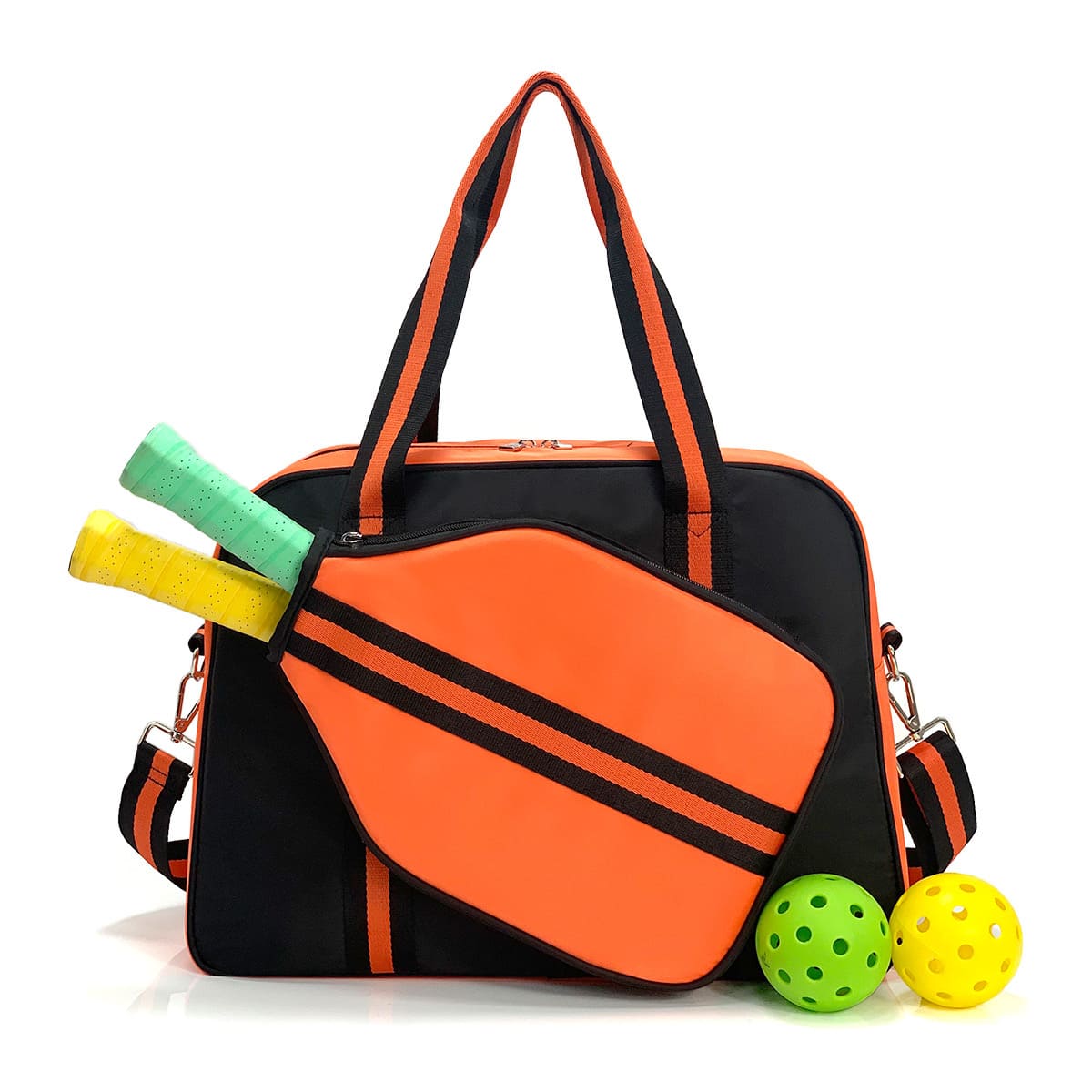
Custom paddle cover
-
Custom carry bag
-
Custom box (color box / gift box)
-
Manuals / instruction cards
My first-order recommendation (100–500 pcs):
-
Customize a paddle cover OR a carry bag first
-
Use label-ready packaging to avoid high box MOQ
-
Don’t lock yourself into a complex insert system too early
About boxes: if you want a box with a custom logo or full design, it usually requires a certain MOQ. So I normally recommend upgrading to custom boxes after your best-selling SKU is confirmed.
A simple upgrade path that works in real business:
-
Phase 1: custom cover / bag + clean label
-
Phase 2: standard box + sticker + basic insert (if needed)
-
Phase 3: custom color box + full insert system for premium SKUs
One detail that reduces returns fast: make your set contents obvious on the front (not hidden on the back). Customers hate “surprise missing items,” even when nothing is missing.
A simple first-order blueprint (3 models that work for online + retail)
Because you are for online/ offline, my suggestion is to start with 3 models to build a clean product line:
-
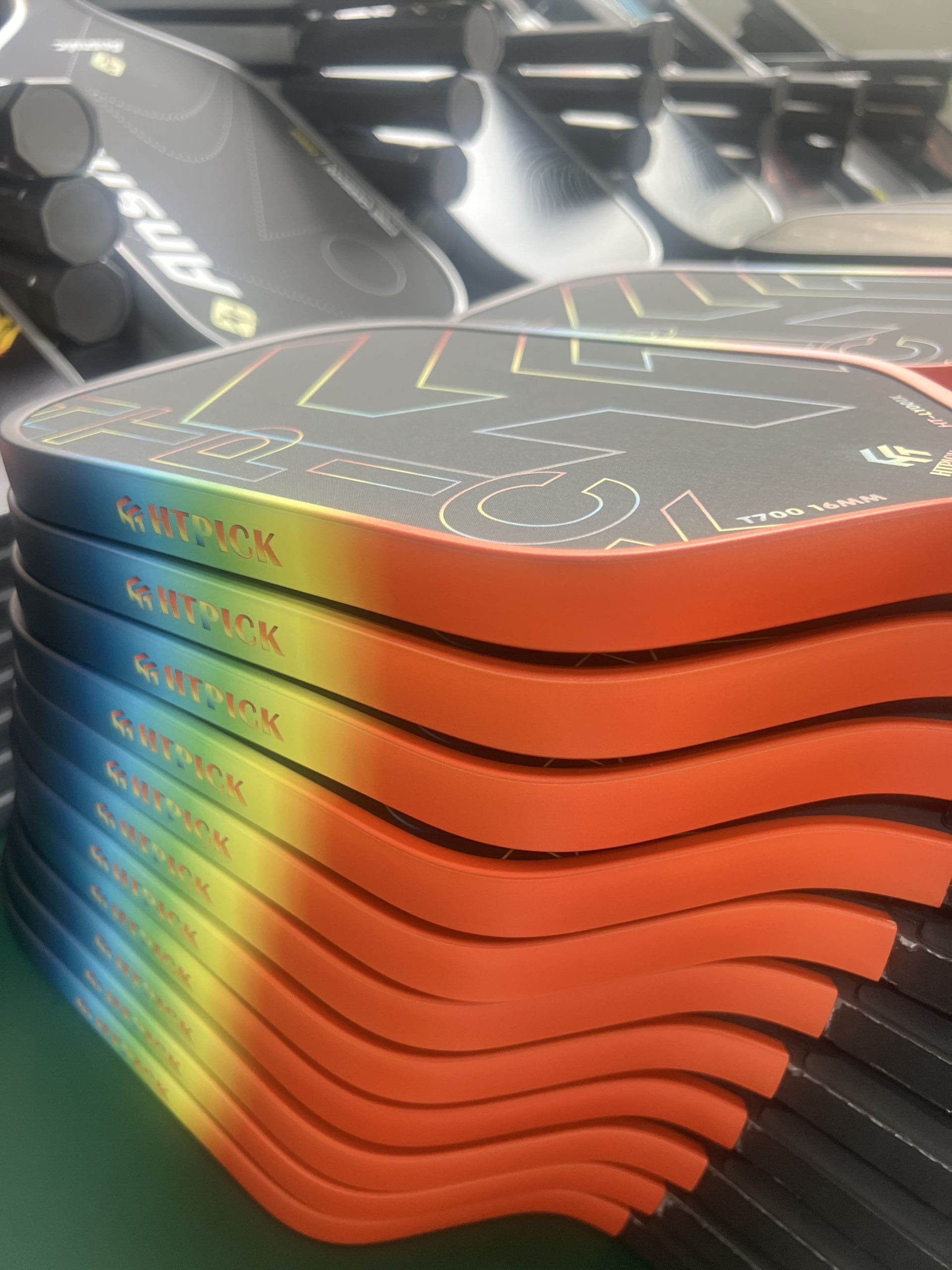
Entry model: for new players / clubs (cold-press T700, 13 or 16 mm)
-
Premium model: main seller (thermoformed T700, 16 mm, foam-injected edge)
-
Flagship model: for A-level players (Gen 4 core or TruFoam core + EVA -EPP Gen 5 core + raw T700, 16 mm)
This gives you a clean ladder: entry brings volume, premium brings margin, flagship builds brand authority.
Retail-friendly detail: keep the naming simple too (Entry / Premium / Flagship), so your sales staff can explain it quickly on the shelf.
Table: 100–500 pcs decision guide (what to lock vs what to delay)
| Item | Lock Now (First Order) | Delay to Later (After You Have Sales Data) |
|---|---|---|
| Shape / Thickness | Yes — pick 1 hero spec | Extra shapes (only after best-seller is confirmed) |
| Core family | Yes — align to price band | Experimental core variations |
| Artwork + colors | Yes — lock final files + version control | New artwork directions after you know your best-seller |
| Packaging direction | Yes — low MOQ, retail-ready route | Full custom box system |
| Accessories | 1–2 simple items + 1 identity custom touch | Full bundles with many small parts |
How you actually use this table: anything in “Lock Now” must be confirmed before the sample; anything in “Delay” can wait until you have 30–60 days of real sales feedback.
A real case I’ve seen (retail buyer): the “too many options” mistake
I’ve seen smart retail teams do this, so please don’t feel embarrassed if it happened to you, it’s a very common “first-order” move.
Here’s a very typical retail situation I’ve seen (details simplified, but the pattern is real): a retail buyer wanted to look “fully professional” on day one, so they launched too many small variations at a small quantity, multiple colors, multiple grip details, and mixed surface feels under the same “series name.”
What went wrong wasn’t product quality. It was retail clarity. On the shelf, staff couldn’t explain why one SKU was $X higher than another in one sentence. Customers picked randomly, then compared them at home and felt “inconsistent.” That’s how “confusion returns” start.
Then replenishment became painful: they couldn’t reorder just one SKU, because packaging and naming were not standardized. Even simple things like barcode placement and carton marking were inconsistent across SKUs.
How they fixed it (and this is the part you can copy):
-
They reset to a 3-model ladder: Entry / Premium / Flagship
-
They locked one hero spec for the Premium model and used it as the reorder anchor
-
They reduced colors to 1–2 and kept the grip/trim consistent
-
They made one packaging system that could be reused (cover-first, then box upgrade later)
-
They standardized carton marking and a simple packing checklist for every set
Once the lineup became easy to explain, everything got smoother: staff training became simple, reorders became predictable, and customer feedback became more consistent.
People Also Ask (FAQ)
What is the safest first order quantity to test the market?
If you’re new, 100–500 pcs is usually enough to validate positioning and packaging. If you already have channels, more than 500 pcs gives you better cost efficiency and cleaner inventory flow.
Should I do a custom box at 100–200 pcs?
Usually no. Start with a cover or bag packaging, then upgrade to custom boxes after your best-seller is confirmed.
How do I avoid “sample is good, mass production feels different”?
Lock one hero spec, keep artwork/version control strict, and avoid late-stage “small changes” that accidentally shift the product feel and look.
Can you manufacture paddles designed to meet USAP requirements?
Yes, our pickleball paddle can meet USAPA standards
What’s the simplest way to make my line look “premium” without increasing risk?
Lock clean artwork, keep one consistent trim/grip identity, and choose a packaging route that looks retail-ready without forcing high box MOQ. Premium doesn’t need complexity; it needs consistency.
Final note
I don’t think your first order should be “cheap.” I think it should be repeatable. If you tell me your channel and your starting quantity, I’ll help you choose a first-order setup that sells cleanly now, and upgrades smoothly later without creating dead stock.