跳到内容
跳到内容 

Most buyers love the word “spin.” It sounds like an easy win.
But after working on real OEM projects, I’ve learned something: the biggest spin problems don’t show up on day one. They show up after launch, when a paddle that felt perfect as a sample starts wearing unevenly, or when mass production feels slightly different from the first batch.
That’s why this guide is built in the exact order I use when I help brands make decisions: surface first, texture method second, durability reality third, then a simple checklist for safe spin wording.
Spin: what a surface can (and cannot) change
Spin is mainly created by friction + consistent bite. A good surface helps the ball “grab,” but if the texture wears off quickly, the spin advantage disappears and complaints start.
A surface cannot “save” a bad paddle structure, but it can absolutely ruin a good paddle if it becomes inconsistent after a few weeks of play.
Surface material families you actually choose
I’m not going to use broad “composite” categories here. I’ll stick to what buyers actually discuss in OEM projects: raw carbon fiber, 3K/12K/18K weaves, Kevlar, and titanium weave.
Raw Carbon fiber: the mainstream spin/control choice

Raw carbon fiber is popular because it gives a very direct “bite” feeling, and it pairs well with matte texture methods. For most brands, if you want a safe, mainstream “spin story,” raw carbon is the easiest surface to explain to customers.
What you should focus on is not “T700 vs T300” in marketing terms, but whether the factory can lock the surface finish and keep it consistent across batches.
3K / 12K / 18K carbon weaves: visual identity vs real spin
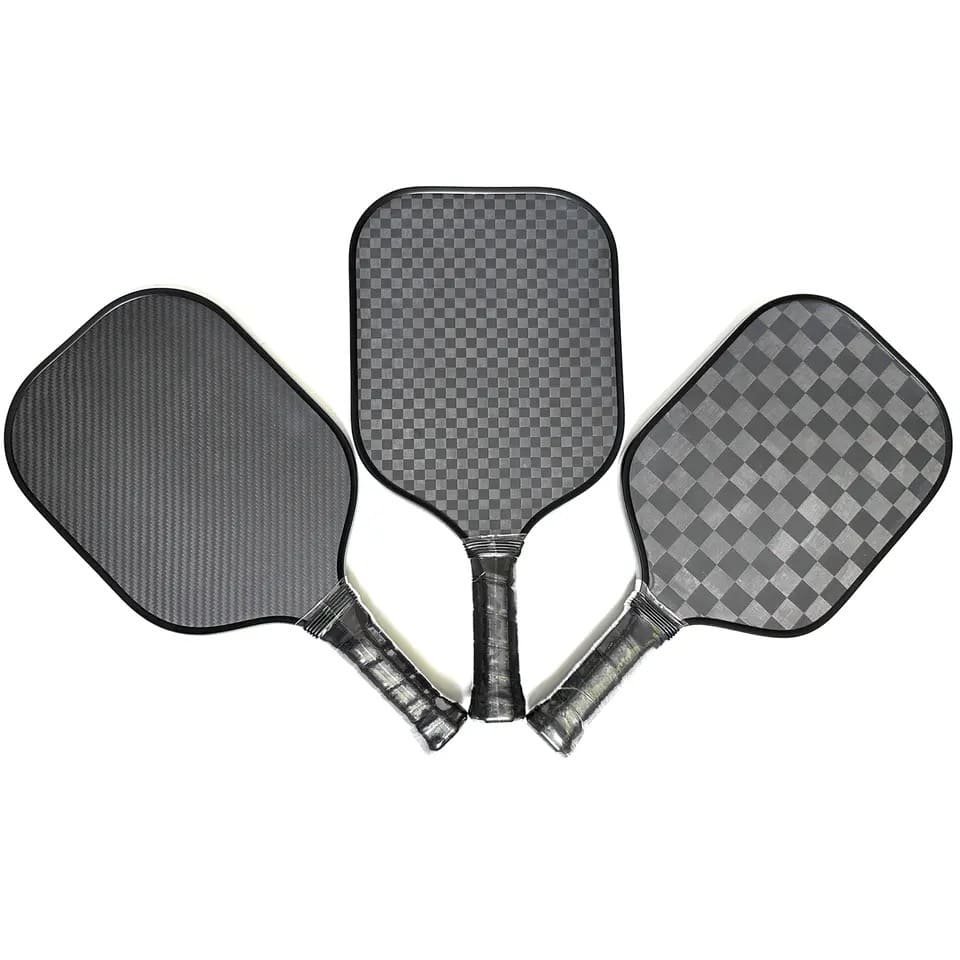
Many buyers assume “bigger K means more spin.” In real OEM work, the K number is often more about weave look and brand identity, while the real spin difference comes from the final surface treatment (your matte/texture route).
A simple way to position them:
- 3K feels classic and premium without being too aggressive.
- 12K/18K looks bolder and more “distinct,” but it needs better process control to keep the finish stable.
Kevlar: flagship differentiation with a distinct feel

Kevlar is often chosen when a brand wants a strong “story” beyond raw carbon, durability perception, unique feel, and premium differentiation. Spin can be very good, but it depends heavily on the texture route you choose.
My practical advice: don’t force Kevlar into every SKU. Use it where you want a flagship identity and margin.
Titanium weave: feel tuning + branding, not “magic spin”

Titanium weave is often used to tune feel and stiffness and to create a premium, technical look. But for spin performance, the surface still lives and dies by your texture method and finish consistency.
The two matte texture methods that matter most in real OEM
This is where most returns come from: buyers pick a texture that looks amazing on the sample, but it’s the wrong match for the artwork, or it wears unevenly after launch.
At iAcesport, we commonly use two matte routes: cloth-matte and spray-matte. Which one you should choose depends on your design style.
Cloth-matte: best for clean design + stronger durability
If your face design is clean and minimal, cloth-matte is often the safer option. It tends to hold a more stable “bite” feeling over time and feels premium in hand.
Best surface materials for cloth-matte (practical OEM rule):
- T700 is a great match.
-
If your face material already has its own visible texture/pattern, cloth-matte is usually the better choice, such as Kevlar, 3K, 12K, 18K, titanium weave.
Because if you go with spray-matte and large-area color graphics, it can cover and weaken the natural material texture, which is often the reason you chose that material in the first place.
Pros
- Stronger durability in many real-use cases
- More consistent bite over time
- Great premium feel for minimalist branding
Cons / limitations
- Not ideal for large-area solid background color blocks
- Design flexibility is lower than spray route
Spray-matte: best for big background colors and full graphics
In practical OEM surface choices, spray-matte is typically best suited for T300 and T700 faces.
If your design has large solid background colors or full-bleed graphics, spray-matte usually looks cleaner and more uniform. It gives you more freedom on artwork styles.
Pros
- Works best for big background colors and full graphics
- Very flexible for artwork styles
Cons / risks
- Durability depends heavily on process control and uniformity
- Can wear unevenly if not tuned well
The simplest rule I use: design → texture
If your paddle face is mostly solid background color, choose spray-matte.
If your design is clean and minimal, choose cloth-matte for stronger durability.
Surface + texture options for spin (OEM decision view)
| Surface family | Texture route | Spin feel (bite) | Durability reality | Best for (Entry / Profit / Flagship) | Design fit | Buyer risk notes |
|---|---|---|---|---|---|---|
| Raw carbon (T700/T300) | Cloth-matte | Strong, stable bite | Usually stronger long-term bite | Profit / Flagship | Clean/minimal | Needs finish lock for mass production |
| Raw carbon (T700/T300) | Spray-matte | Strong initial bite | Depends on uniformity | Entry / Profit | Big background colors | Watch uneven wear if process isn’t tight |
| 3K carbon weave | Cloth-matte | Strong + premium feel | Strong if finish is locked | Profit / Flagship | Clean/minimal | Great “premium look” without being too aggressive |
| 12K / 18K weave | Cloth-matte | Strong bite + bold identity | Can be strong, but needs control | Flagship | Clean/minimal | Higher requirement for process stability |
| Kevlar | Cloth-matte | Distinct bite + unique feel | Often strong when matched right | Flagship | Clean/minimal | Use for differentiation, not every SKU |
| Titanium weave | Cloth-matte | Controlled bite | Stable if finish is consistent | Flagship | Clean/minimal | Spin depends on texture, not the word “titanium” |
Durability reality: what happens after 30 / 60 / 90 days
The most common “spin complaint” is not “spin is low.” It’s:
“Spin was great at first, then it became inconsistent.”
What wear usually looks like: smooth patches, reduced bite, and “one area feels different.”
Before mass production, the smartest move is to lock four things:
- Final artwork version
- Texture route (cloth vs spray)
- Surface finish details (don’t “slightly change” later)
- A simple sampling rule for consistency checks
How to talk about spin safely
I won’t write rule arguments in a blog post, because rules can be updated and enforcement can vary. What I will do is give you safe wording patterns that reduce risk.
Safe spin wording examples:
- “Textured surface designed for spin and control.”
- “Consistent matte finish for reliable ball bite.”
Avoid absolute claims like “maximum spin,” “legal for all tournaments,” or implying approval if you’re not listed.
If you target tournament players, the safest rule is simple: only claim listing/approval status if it matches the official list for that exact model/version.
Buyer checklist: 15 questions to ask a factory about spin surfaces
Here are the questions that immediately reveal whether a factory truly understands spin surfaces or is just using marketing words:
-
What texture route are you recommending for my artwork style, cloth-matte or spray-matte, and why?
-
Which parts of the design force you to use spray-matte (large base color areas)?
-
What is your durability expectation for this surface after real play?
-
What causes uneven wear most often in your experience?
-
What surface changes do you consider “not allowed” without re-sampling?
-
How do you lock the surface finish for mass production?
-
What batch-to-batch checks do you do for surface consistency?
-
If my brand needs two SKUs (entry vs flagship), would you recommend different texture routes?
-
What are the common buyer complaints related to surface, and how do you prevent them?
-
What is your recommended positioning: entry, profit, flagship, for this surface choice?
-
What safe wording would you recommend for product pages regarding spin?
-
What will you NOT promise, even if a buyer asks?
-
If l changes artwork late, what’s the safest way to update without damaging consistency?
Real case (retail/distributor): how one surface decision reduced complaints
A retail buyer once launched a “high-spin” SKU with a full-graphic face. The sample felt great, but after launch they started seeing feedback like: “It doesn’t feel the same after a few weeks,” and “one area feels smoother than the other.”
The root cause wasn’t the carbon material itself. It was the mismatch between artwork style and texture route. That design needed a uniform spray-matte finish, but the buyer was expecting cloth-matte durability behavior.
The fix was simple and practical:
- For the main bestseller SKU, we switched to a cleaner design that allowed cloth-matte for stronger durability.
- For the high-graphic SKU, we kept spray-matte but tightened the process control and buyer expectations.
After that, the buyer told us their “spin wore off” complaints dropped noticeably, and reorders became much easier because the product behavior was more predictable.
A practical note from iAcesport
If you tell me your channel, your target retail price, and your design style (clean vs full graphics), I can recommend a surface + texture route that balances spin, durability, and safe marketing wording.
Most brands don’t lose because they didn’t work hard. They lose because the “small surface decision” created big complaints later. I’d rather help you lock it correctly before you scale.